
REVIEW · SAFARI
Jebel Safari – Tour della montagna
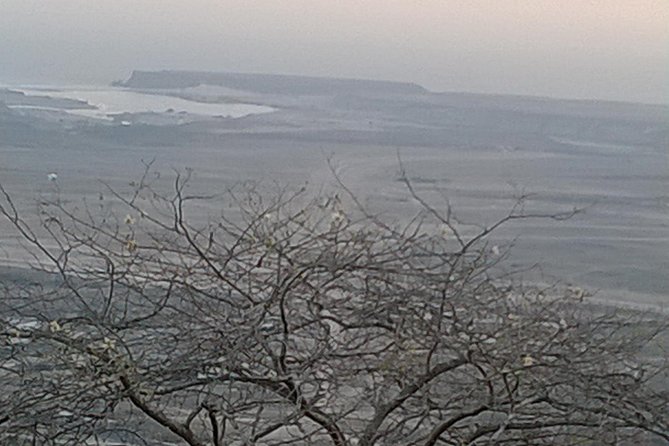
Mountains, sinkholes, and old ports in one day. I love how this Salalah tour strings together two very different kinds of wonder, UNESCO Sumhurram and the Tawi Attir sinkhole, both in a single flowing route. I also like that you get proper viewpoints at the highest elevations, then cool it off later with the Wadi Hinna baobab forest and the dhow harbor at Mirbat. One catch to plan for: it is an all-day, stop-and-go drive, so you’ll want comfortable shoes and a good breakfast, especially if you are sensitive to heat on higher sections.
This is a private tour for up to four people with pickup, so the day feels tailored to your group, not to a big bus crowd. At the highest panoramic spot, you’ll enjoy a picnic lunch while the mountains and reserve area sit right in front of you, which is a rare “pause and take it in” moment in an 8-hour schedule. If you prefer a guide who keeps things easy going and adds extra stops when time allows, the experience has that kind of rhythm, including guidance like Salim in past bookings.
In This Review
- Key highlights you will feel on this mountain loop
- Why Jebel Safari in Salalah is built for real variety
- Taqa village: stepping into a governor’s ancient home
- Khor Rori lagoon and Sumhurram UNESCO: old trade routes meet sea air
- The highest mountain panoramic tour: viewpoints and the Arabian leopard reserve edge
- Tawi Attir sinkhole, the bird’s well: where geology turns visual
- Wadi Hinna baobab forest: why this stop surprises people
- Mirbat and the dhow harbor: finishing with working boats, not just scenery
- Price and value: what $502.57 per group actually buys you
- What to expect on the day: pacing, timing, and comfort
- Who this tour suits best
- Should you book Jebel Safari – Tour della montagna?
- FAQ
- How long is the Jebel Safari tour?
- Where does the tour take place?
- Is pickup included?
- Is this a private tour?
- What is the group size limit?
- What does the price include?
- What sights are included in the itinerary?
- Is there a place for a picnic lunch?
- Can I cancel for a full refund?
- Is the tour suitable for everyone?
Key highlights you will feel on this mountain loop
- Taqa village and a traditional Omani home inside the governor’s house
- Khor Rori lagoon plus UNESCO Sumhurram, the Hadramout spice-trade port
- Tawi Attir, the bird’s well sinkhole, with desert rose and dragon blood trees
- High panoramic viewpoints near the start of the Arabian leopard national reserve
- Wadi Hinna baobab forest stop, a surprising burst of life in Dhofar
- Mirbat and the dhow fishing boats on the Indian Ocean
Other 4WD days across Salalah
- East Salalah Mountain Safari, Wadi Darbat, Beach, Camels, Dunes★ 5.0 · 206 reviews
- Mountain Safari Private Tour★ 5.0 · 105 reviews
- Sunset Desert Safari Salalah Tour in Rub Al Khali – Empty Quarter★ 5.0 · 91 reviews
- Salalah: Sunset Desert Safari – Rub Al Khali – Empty Quarter★ 4.6 · 79 reviews
Why Jebel Safari in Salalah is built for real variety
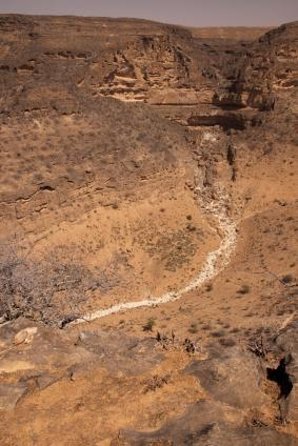
Most Salalah outings pick one theme, beach, or archaeology, or hikes. This one is different because it’s built like a circuit across Dhofar’s layers of scenery. You start in a village setting, move into lagoon and ruins, then climb into the mountains, pause at geological wonders, and finish with a working-coast view at Mirbat.
What you get for the time is real texture. One moment you’re looking at how people lived in Taqa. The next you’re standing near a UNESCO port tied to long-ago Indian Ocean spice trade. Then you’re watching for birds and plant life around sinkholes, and later you’re seeing baobabs growing where you might not expect them.
You’ll also notice the day has built-in “change of pace.” There are high viewpoints, but there are also quieter stops where you can slow down, take photos, and just absorb the Dhofar air.
Taqa village: stepping into a governor’s ancient home
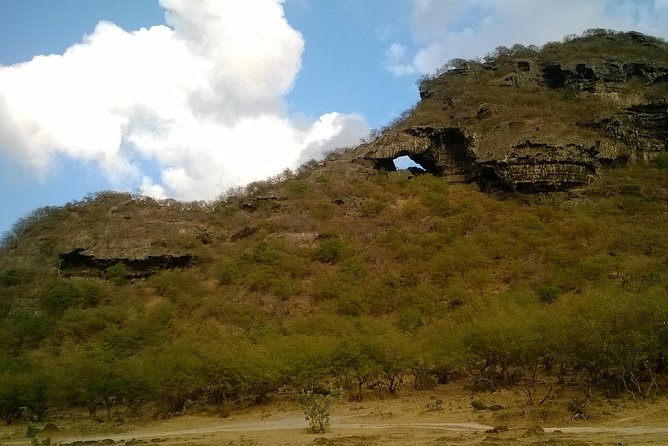
Your morning begins with a drive to the village of Taqa. The standout here is entering the ancient house of the governor and seeing the inside of a traditional Omani home, not just passing by from the outside.
Why that matters: in many places, you only ever get the exterior of “heritage” buildings. Here, you get a chance to understand domestic design and how everyday space works in an Omani context. Even if you aren’t an architecture nerd, you’ll usually find yourself looking at layout choices like how the rooms flow and how the home is arranged for daily life.
Practical note: since this is inside a traditional home, dress with respect and keep your movements calm. If you have a camera, it’s worth asking before you start shooting indoors.
Khor Rori lagoon and Sumhurram UNESCO: old trade routes meet sea air
After Taqa, you head toward the lagoon of Khor Rori, then on to Sumhurram, a UNESCO site.
Khor Rori is one of those locations where the air changes. Even when you’re not in “beach mode,” a lagoon gives you that softer light and a different kind of horizon. It’s a nice reset between village life and ancient stonework.
Then comes Sumhurram. This is described as a port built by the kingdom of Hadramout to control the spices trade on the Indian Ocean. That sentence is doing a lot of work. It tells you this was not a random harbor, it was tied to commercial control, shipping, and a network that connected Arabia to the wider ocean world.
What I like about pairing lagoon and ruins is that the environment helps you imagine the purpose. A port needs access to water routes. Standing in the area, you’re better able to connect why people built here and what they were trying to manage.
The highest mountain panoramic tour: viewpoints and the Arabian leopard reserve edge
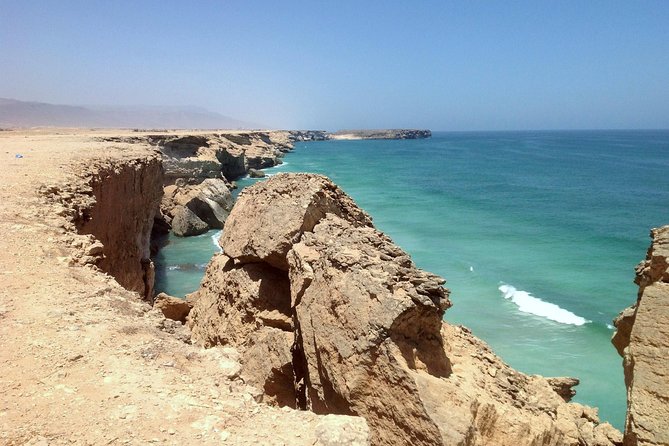
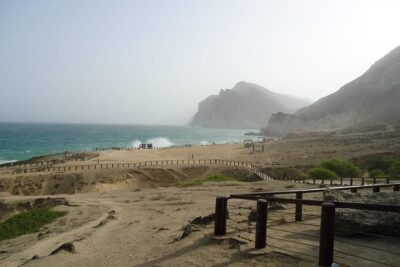
From Sumhurram, the tour shifts into a panoramic mountain drive, described as traveling through the highest mountain of the region. This is where the day earns its “mountain safari” label.
The route culminates at a high panoramic spot where the national reserve of the Arabian leopard starts. That doesn’t mean you’re guaranteed to spot a leopard. What it does mean is that you’re operating at elevations and habitats where the reserve begins, so the scenery feels more wild and less settled.
This is also your picnic lunch stop. That timing matters, because lunch at a viewpoint changes how you experience the afternoon. Instead of rushing through a final stretch, you get to sit, look out, and let the geography settle in your brain.
If you care about wildlife: stay on the path where the guide directs you, keep your voice down, and treat animals as a bonus, not a promise.
Tawi Attir sinkhole, the bird’s well: where geology turns visual
Next you reach the sinkhole area of Tawi Attir (also spelled Tawi Ateer in some parts of the day). It’s specifically referred to as the bird’s well, and you’re also told it is the second largest sinkhole on earth.
That’s a big claim, and it shapes the expectation. You’re not looking at a small oddity. You’re seeing a landscape feature that can shape local vegetation and wildlife patterns, which is why you’ll also be able to see desert rose and dragon blood trees there.
Here’s the practical takeaway: sinkhole stops can be photogenic, but they can also be uneven and hot, depending on the day. Wear shoes with grip. Slow down near edges or where paths look slick. If your group has anyone with mobility limits, it’s smart to tell the guide early so they can position you for the best views with the least hassle.
This is also one of the longer “set-piece” stops, and you’ll have an admission ticket included for the Teeq Cave and Tawi Ateer sinkhole stop (about an hour).
Wadi Hinna baobab forest: why this stop surprises people
After the highest viewpoints, the drive down brings you through Wadi Hinna, followed by a stop to see the baobab forest that grows there.
Even for seasoned travelers, baobab forests in Oman can feel like a plot twist. The idea that a wadi supports large, long-lived trees helps you understand how Dhofar’s conditions can support very different plant life within a limited region.
Why I like this part of the route: it provides “life” after the stone and water stops. Lagoon, ruins, sinkholes, viewpoints, and then suddenly you’re looking at a forest. It gives the day balance.
Tip: take a few minutes to observe from multiple angles if the space allows. Baobabs don’t just look good, they also create a natural rhythm in how the ground and shade work. If your camera loves shade contrast, this is where you’ll use it.
Mirbat and the dhow harbor: finishing with working boats, not just scenery
Before returning to Salalah, the tour reaches Mirbat, a town where fishermen still sail on traditional boats of the Indian Ocean, known as dhows.
This is a strong closing note because it grounds the day in living culture. The previous stops are about heritage and natural features. Mirbat adds a present-day pulse, the kind you feel when people are actively using what they’ve been using for generations.
Even if you only have time for a brief look, the dhow scene tends to stay with you. There’s a different mood at a working harbor. It’s less “tour photo” and more “real life in motion.”
Price and value: what $502.57 per group actually buys you
The price is listed as $502.57 per group, up to 4 people, for the whole experience (about 8 hours). That can sound steep if you compare it to shared buses. But you’re buying a private day with pickup and a custom route across multiple major stops.
Think of value in terms of convenience and time. If you tried to stitch together Taqa, Khor Rori, Sumhurram, mountain viewpoints, sinkholes, Wadi Hinna baobabs, and Mirbat on your own, you would spend a lot of energy on routing, timing, and “where do we stop for the best angles” decisions.
Also, some costs are built into the day. A mobile ticket is included, and an admission ticket is included for the Teeq Cave and Tawi Ateer sinkhole stop (about an hour). That reduces the little friction points that add up on self-guided days.
A private group of up to four is ideal because it lets you spread the cost. If you’re traveling as a pair, this is often a good middle ground between hiring a full car alone and joining a larger group.
What to expect on the day: pacing, timing, and comfort
This tour is scheduled for roughly 8 hours, starting in the morning with pickup offered. The day is a sequence of targeted stops, so you’ll likely spend more time watching and walking short distances than doing long treks.
Still, the route includes mountain driving and sinkhole terrain, so you should plan for uneven ground and changes in temperature as you move between elevations. Bring sun protection, and dress in breathable layers. In dry mountain and wadi areas, conditions can shift fast.
For photos and videos, you’ll be happiest if you pack with quick access in mind. You’ll likely want to switch between wide shots (panoramas, sinkhole scale, baobabs) and tighter details (tree shapes around the sinkhole area, architectural cues in the traditional home).
Finally, the picnic lunch at the highest panoramic spot is a key moment. Treat it like part of the experience, not just a break. Eat, look around, then let the afternoon stops feel like a continuation instead of a sprint.
Who this tour suits best
I think this tour fits best if you want a single Salalah day that covers:
- heritage and archaeology (Taqa home, Khor Rori, Sumhurram)
- natural wonders (Tawi Attir sinkhole with bird well framing)
- mountain viewpoints (including the reserve area start)
- and practical “real-world” culture (Mirbat dhows)
It’s also a great match for small groups who want privacy, up to four people. Families and friends tend to like the shared pace, while couples enjoy the mix without having to plan multiple separate outings.
If you are only after one thing, say, strictly ruins or strictly hiking, you might feel the day is too varied. But if you like variety and you want maximum “Dhofar in a day,” this is the kind of route that works.
Should you book Jebel Safari – Tour della montagna?
Yes, if you want a private, efficient, well-paced day that links Dhofar’s major contrasts: village home interiors, lagoon and UNESCO port archaeology, dramatic sinkhole geology, mountain viewpoints at the edge of the Arabian leopard reserve area, baobab trees in Wadi Hinna, and a dhow harbor finish in Mirbat.
Don’t book if you want a purely lazy day with minimal walking, or if you are looking for a deep specialization in one topic. This is built for variety, and you’ll feel the driving and shifting elevations as part of the deal.
If you’re the type who likes to come home with photos of very different places, plus a sense of how trade, landscape, and daily life connect in this corner of Oman, this mountain loop is a strong choice.
FAQ
How long is the Jebel Safari tour?
The duration is approximately 8 hours.
Where does the tour take place?
It runs in Salalah, Oman, with stops around Taqa, Khor Rori, Sumhurram, the mountains, Wadi Hinna, and Mirbat.
Is pickup included?
Pickup is offered.
Is this a private tour?
Yes. It is a private tour/activity, and only your group participates.
What is the group size limit?
The price is per group for up to 4 people.
What does the price include?
The tour price is $502.57 per group, up to 4. A mobile ticket is used, and an admission ticket is included for the Teeq Cave and Tawi Ateer sinkhole stop (about 1 hour). Lunch is part of the day as a picnic.
What sights are included in the itinerary?
You’ll visit the traditional Omani home inside the ancient governor’s house in Taqa, Khor Rori lagoon, Sumhurram (UNESCO), panoramic mountain spots including the start of the Arabian leopard reserve area, Tawi Attir or Tawi Ateer sinkhole, Wadi Hinna baobab forest, and Mirbat with dhow fishing boats.
Is there a place for a picnic lunch?
Yes. There is a picnic lunch at the highest panoramic spot.
Can I cancel for a full refund?
Free cancellation is available. You can cancel up to 24 hours in advance for a full refund.
Is the tour suitable for everyone?
Most travelers can participate, and service animals are allowed.
4WD Days Across Salalah


Elsewhere in Salalah, also reviewed
- Half-Day Private Salalah East Tour
★ 5.0 · 3 reviews - Salalah City Tour :Salalah Tours
★ 5.0 · 3 reviews - Salalah East Tour (Full Day Tour)
★ 5.0 · 3 reviews - West Coast Mountains and Beaches (Fazayah beach + Shaat cliff)
★ 5.0 · 3 reviews - Jebel Safari – Tour della montagna
★ 5.0 · 3 reviews
Safari, compared.
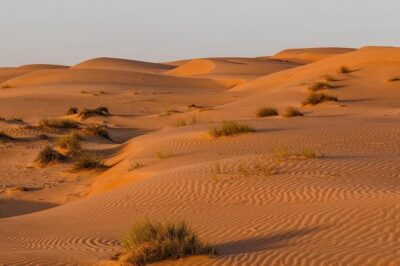 ★ 5.0Desert Safari Sharing ToursFrom $189313 reviews
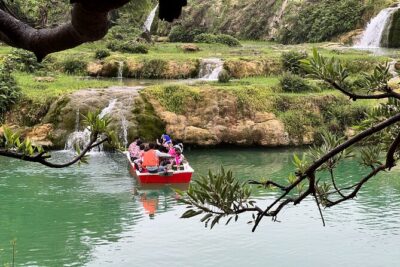 ★ 5.0East Salalah Mountain Safari, Wadi Darbat, Beach, Camels, DunesFrom $45206 reviews
 ★ 5.0Desert Safari PrivateFrom $489177 reviews
 ★ 5.0Mountain Safari Private TourFrom $195105 reviews
 ★ 5.0Sunset Desert Safari Salalah Tour in Rub Al Khali – Empty QuarterFrom $9591 reviews
 ★ 4.6Salalah: Sunset Desert Safari – Rub Al Khali – Empty QuarterFrom $10279 reviews
 ★ 5.0Private Watching Sunset Desert Safari TourFrom $17471 reviews
 ★ 5.0Sunset desert safari tour in Salalah(private tour)From $12558 reviews